Home
Thesis
Background
R'sInsulin's impact on humanityConclusionResearch
Dr. Charles H. Best and Dr. G.R. Williams conducting experiments. University of Toronto.
Diabetes was an inexplicable disease, as former doctors did not know anything about it, and dieting was the only effective way of prolonging lifespan. In 1889, two German researchers, Oskar Minkowski and Joseph von Mering, discovered that removing the pancreas from a dog caused it to develop symptoms of diabetes and die. Indicating the pancreas manages diabetes. Scientists subsequently narrowed the idea to the islets of Langerhans. In 1910, Sir Edward Albert Sharpey-Shafer claimed diabetic patients lacked a specific chemical produced by the pancreas, commonly known as insulin. In 1921, Frederick Banting, Charles Best, James Collip, and John Macleod developed a successful method to extract insulin from the pancreas. Ligating the pancreatic ducts allowed for the digestive enzymes within the pancreas to degenerate. From this, researchers gained complete access to the insulin-producing islets of Langerhans and extracted insulin with a solution of saline. This extract kept a diabetic dog alive for 70 days, and the dog only died after the supply of the extract had depleted. The first diabetic human to receive this treatment dates back to January 1922, when Leonard Thompson, a 14-year-old diabetic, had his blood sugar levels drop significantly within 24 hours after administration, reaching normal levels. These discoveries set the foundation for insulin extraction, paving the path for one of the most revolutionary discoveries of the twentieth century.
________________________________________________________________________________________________________________________________________
Pancreatic Tissue Structure
________________________________________________________________________________________________________________________________________
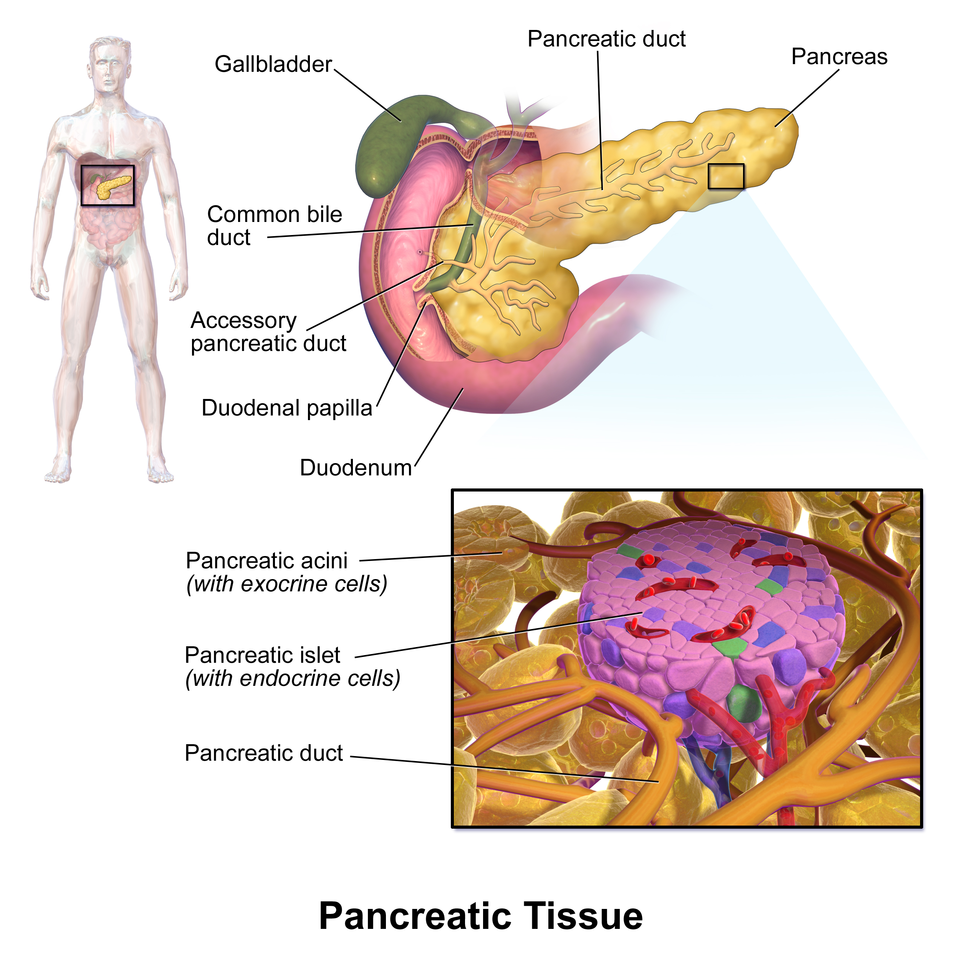
Blausen.com staff (2014). "Medical gallery of Blausen Medical 2014".